Multi-Group Fairness in TabPFN
Evaluating Tabular Foundation Models (TabPFN) on multi-valued protected attributes, applying fairness mitigation, and testing spatial/temporal distribution shift.
FairnessDemographic ParityEqualized OddsDistribution Shift
PythonTabPFNfairlearn
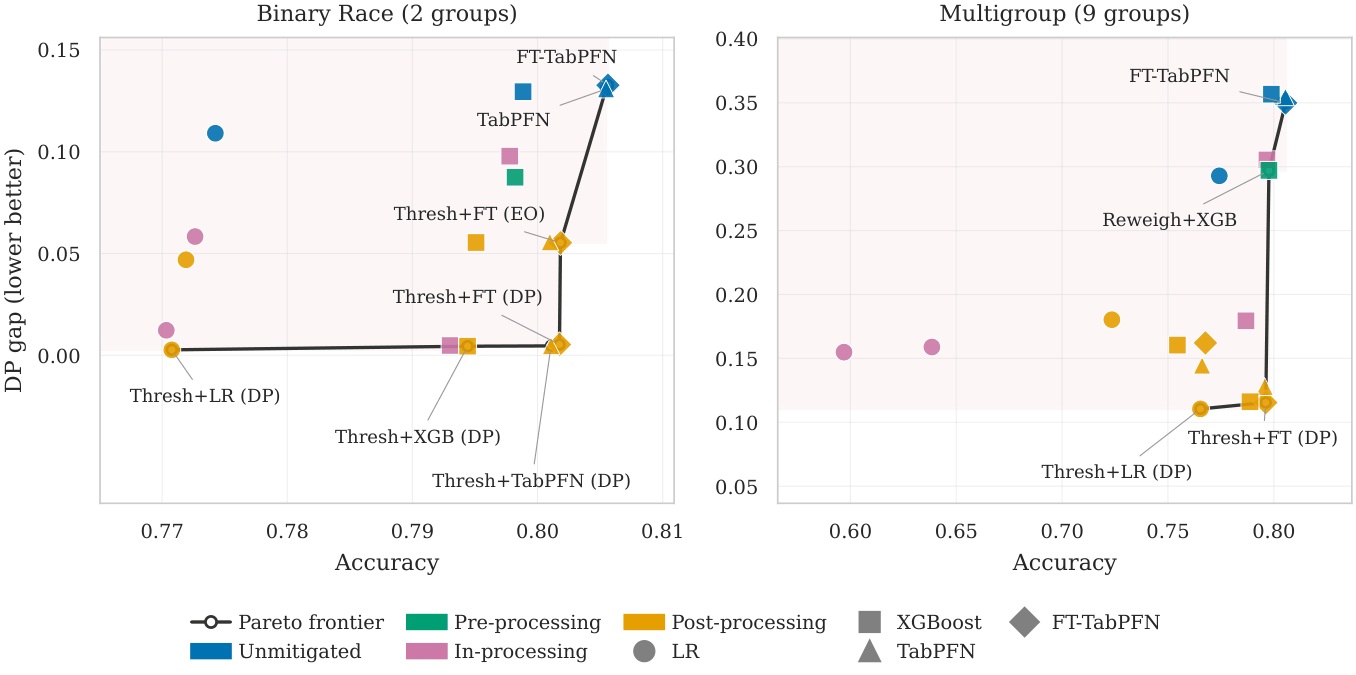
Tabular foundation models such as TabPFN are increasingly applied to high-stakes decisions, yet their fairness has been studied only for binarized protected attributes and without mitigation. Using income data from the American Community Survey, this project evaluates TabPFN's group fairness on the nine-category US Census race variable and its intersection with sex, and tests standard pre-, in-, and post-processing mitigation.
At full cardinality the unmitigated model is not group-fair: its demographic-parity and equalized-odds gaps match those of logistic regression and XGBoost, so its advantage under a matched training budget is confined to accuracy. Refining a grouping can never shrink a max-pairwise gap, but the size of the effect is an empirical question. On identical individuals, binarizing race understates the demographic-parity gap by a factor of two to three. Per-group threshold optimization is the most effective mitigation, but under natural distribution shift it becomes the most fragile, and TabPFN is no more robust than a tree ensemble. The results are established on a national sample and confirmed across states.
Collaborators
Solo project