Biases in T2I Generation: An Analysis of Qwen-Image
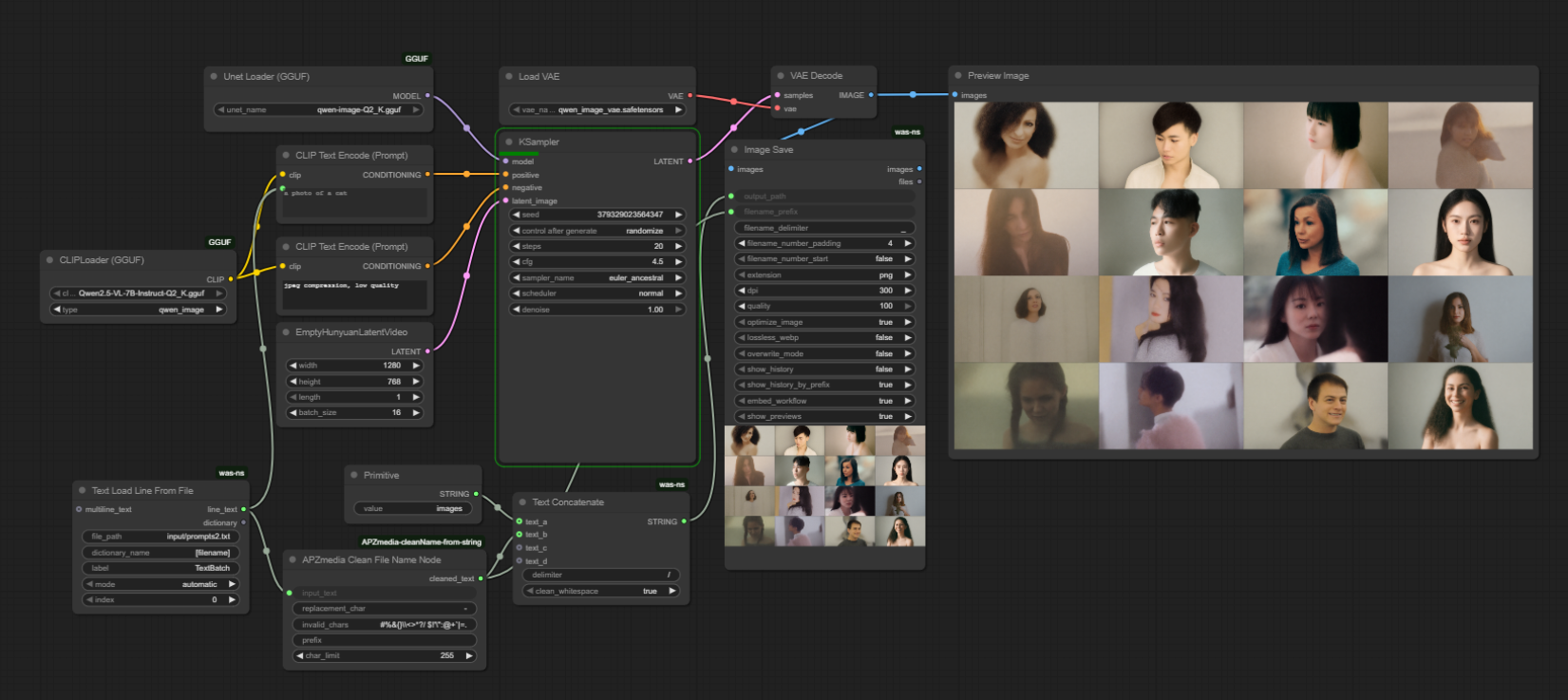
Investigation into the inherent biases present in modern Text-to-Image (T2I) generation models. Utilizing a local installation of the Qwen-Image model via ComfyUI, we generated batch outputs across various prompts to identify representational harms.
This project consists on an investigation into the representational biases of Qwen-Image, a large-scale Text-to-Image model developed by Alibaba Cloud. To conduct the study within specific hardware constraints, a quantized version of the 20-billion parameter Multimodal Diffusion Transformer model was used. By employing an automated, local ComfyUI workflow, the methodology intentionally bypassed commercial safety filters to directly analyze the model's intrinsic latent distribution and raw training weights without external alignment interference.
The analysis uncovered profound gender and skintone disparities. The model demonstrated extreme occupational segregation, heavily associating women with caregiving roles while exhibiting a near-universal "masculine collapse" across intellectual, high-status, and high-wealth categories. Skintone representation proved to be highly skewed and context-dependent. Although the model heavily defaulted to generating East Asian subjects for general or non-descriptive prompts, it overwhelmingly shifted to a White default when generating subjects associated with intellectual traits or high socio-economic status.
Beyond demographic imbalances, the study identified significant geo-cultural and linguistic anomalies within the model's latent space. It exhibited a maximal American cultural default when generating architectural concepts, uniformly producing American styles for residential homes regardless of whether the prompt asked for a beautiful or ugly aesthetic. Surprisingly, while the model lacked internal censorship for sensitive historical topics like the 1989 Tiananmen Square protests, it experienced a core linguistic failure when prompted with fundamental Simplified Chinese characters, resulting in hallucinations.
The GitHub repository is not currently available.
Collaborators
Solo project